

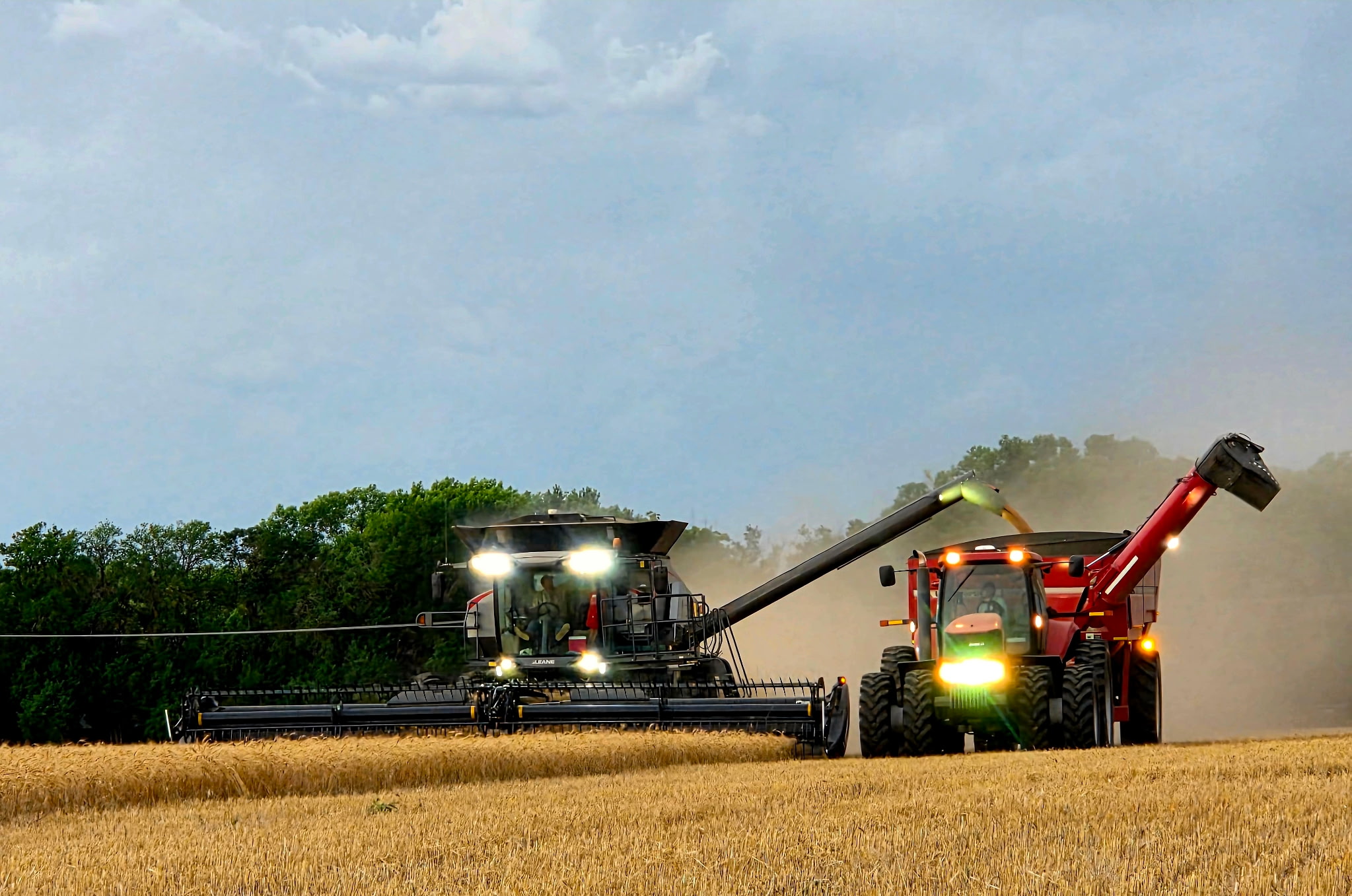
Farmers in the area have largely wrapped up the 2026 wheat harvest, and the yields varied widely.
Bryson Huxman, a second-generation farmer who owns and operates Happy Hallow Ag in rural Moundridge with his wife Grace, said he saw average to below-average yields from his more than 500 acres of wheat.
According to Adam Butler, vice president of grain operations at Mid-Kansas Cooperative in Moundridge, producers saw everything from 10-50 bushels per acre.
“It’s low,” he said.
On average, local crops brought in 30-35 bushels per acre.
The U.S. Department of Agriculture’s National Agricultural Statistics Service released a crop progress report on June 22.
The data showed Kansas wheat conditions are rated as 55% “poor” to “very poor” and 45% “fair” to “good.” None of the wheat has been rated as “excellent.”
Prior to combines rolling through the fields, farmers braced for a down year as estimates predicted lower-than-normal yields.
Because of that, Butler said, most of the producers he’s spoken with haven’t been too upset by the results of this year’s crop.
“Obviously it wasn’t a bumper crop. It wasn’t even really a normal crop,” he said. “But they’re OK with it, so it was a good harvest.”
Even so, Harvest Public Media’s Calen Moore reported that Kansas has had “one of its smallest wheat crops in 50 years.”
A May report from USDA’s Economic Research Service projected a 54-year low for U.S. wheat, making it the smallest crop nationwide since 1972.
The report predicted 1.56 billion bushels of wheat this year, down 21% from 2025. The weather is to blame.
“We had such dry weather and a lack of rain,” Butler said.
Huxman agreed, saying he expected lower yields because it had been so dry before it came time to get the grain out of the fields.
Specifically, drought conditions have been impacting Kansas producers.
According to the U.S. Drought Monitor, nearly 60% of the state is experiencing “extreme” or “exceptional” drought conditions. Only northeast Kansas is drought-free.
This caused the wheat to reach maturity earlier than normal, resulting in one of the earliest harvests in recent years.

Kansas Wheat, a consortium of the Kansas Wheat Commission and the Kansas Association of Wheat Growers, predicted in April an early harvest.
“It was about 10 days early due to the warmer winter and spring,” Huxman said.
On May 12, Romulo Lollato, Kansas State University wheat production specialist, told the K-State Extension news service those predictions were accurate, saying the crop was three weeks ahead of schedule.
Then, at least in the Moundridge area, it started to rain, which kept farmers out of the fields.
“We like to say that Mother Nature always pushes us to where we should be,” Butler said.
Because of the growing and harvesting conditions, some wheat was left in the field.
“The sad part is that it was so hot and dried for so long that there were so many acres that just didn’t get cut,” Butler said. “There was a lot of wheat out there that didn’t come in.”
In 2025, 6.8% of the crop was deserted, according to USDA reports.
Logan Simon, an agronomist for Kansas State University, told Harvest Public Media that 20% of the 2026 wheat crop in Kansas has been abandoned.
Butler said the Moundridge area didn’t have as much abandonment, though.
Now area farmers are looking ahead to the fall crops, which are already planted.
“There’s hope for fall,” Butler said. “Because of all the rain we’ve had, the fall crop is looking a lot more promising.”
Huxman, who also plants beans, corn, milo, oats and more, agreed.
“It’s looking good right now with the recent rains,” he said. “I’m concerned a bit about the current heat, but, overall, it’s looking good.”
USDA corn and soybean projections are holding steady.
Butler said this works well for the Moundridge area, especially as weather patterns shift and commodity and input prices change.
“Kansas is moving more toward corn,” he said. “Last year was a great year for corn, and I think there’s an opportunity to see even more of that this year.”
Soybeans could also be bountiful during the fall harvest.
“I think we’ll see a lot more beans this year,” Butler said.
Despite adjustments, Kansas doesn’t seem poised to lose its title as the “Wheat State.”
“You don’t see a drastic shift yet,” Butler said. “We’ll still have a bunch of wheat.”
Altering what is planted each year is how farmers deal with the business of farming.
Lower yields add stress to producers, who are already facing rising fuel and fertilizer prices due to the Strait of Hormuz closure and trade disruptions brought about by national politics, Butler said.
“Farmers have done this long enough to know there’s going to be conditions year over year that may affect how the crops grow and what they do, but a lot of times that comes back,” he said. “They’re pretty resilient. Crops and farmers.”
Being able to go with the flow and adapt to changes is part of what makes local farmers successful, Huxman said.
“It’s the love of farming and witnessing my family and farm grow that drives me,” he said.
Grace Huxman also appreciated how farming brings her family together.
“I enjoy it because it’s something we can do as a family,” she said. “It’s quality time spent with my husband and kids.”
By helping with the family farm, the Huxman children receive a hands-on education about rural life.
“They’re able to learn so much at a young age that most don’t get to,” Grace Huxman said. “They are learning to drive, to take risks, and the business aspect of farming, and we’re right beside them. We are teaching the kids how it all works.”
Additionally, Bryson Huxman said being his own boss is nice.
“It’s the freedom,” he said. “It’s the ability to control your own schedule.”
Enora Huxman, 8, said she enjoys working on the farm because she gets to learn “to drive the grain cart,” and Colton Huxman, 5, said his “favorite part was riding in the combine.”
Even so, the end of harvest is always welcome.
“There is a nice sense of relief when it’s successfully done, the fields are cut, the grain is in the bins, and we’re home,” Grace Huxman said.
— Casey Dishman contributed to the reporting of this story.